
Animal Health
Brucellosis
Wyoming’s Brucellosis Mitigation Program*
Testing and bangs vaccination historical data from the previous fiscal year
the ranch
53,423
9,365
8,843
154,602
administered
6,656
*Annual testing and vaccination data, FY 2025
Overview
Brucellosis is a bacterial disease caused by Brucella abortus that primarily affects cattle, bison, yak, and elk. Brucellosis is a zoonotic disease and can cause severe, chronic infection in humans.
Due to an extensive eradication program, brucellosis has been eliminated in livestock and wildlife from most of the United States. The last remaining reservoir of the disease includes elk and bison in the Greater Yellowstone Area (GYA). In the GYA, brucellosis infected elk pose a risk of infection to cattle, domestic bison, and yak. To address this issue Idaho, Montana and Wyoming have established Brucellosis Designated Surveillance Areas (DSA) where cattle, domestic bison and yak are required to adhere to testing, vaccination, and identification requirements.
For these reasons, the Wyoming Livestock Board administers the Chapter 2 Brucellosis Management and Mitigation Rules.
- All cattle, bison and yak must be vaccinated for brucellosis.
- Females leaving the DSA must have appropriate identification.
- Females 1 year of age and older must test negative for brucellosis prior to leaving the DSA.
- WLSB has a voluntary brucellosis mitigation program that provides compensation for brucellosis testing and adult brucellosis booster vaccinations.
What are the signs of brucellosis infection in livestock?
Brucellosis infection in cows includes abortion, decreased fertility, retained placenta, and decreased milk production. Calves born to infected cows may be weak, and develop arthritic joints. Infection in bulls causes inflamed testicles and infertility.
How is brucellosis transmitted?
To other animals:
Transmission of B. abortus occurs primarily during calving, or through exposure to abortions from infected animals. B. abortus is shed by an infected female in placental membranes, fluids, vaginal discharge, and aborted fetuses. The bacteria may be ingested or inhaled, and subsequently infect other susceptible animal(s). Intact, pregnant females pose the highest risk of disease transmission due to the ability to shed the bacteria in aborted tissues and during calving.
To humans:
Transmission to humans occurs primarily through contact of infected reproductive tissues and fluids. Pasteurizing milk and properly cooking meat destroys the bacteria. Consumption of raw milk, which has not undergone the pasteurization process, is a risk for brucellosis transmission.
Brucellosis Vaccination Requirements
- In Wyoming, all intact female cattle, bison, and yak grazing in the Required Brucellosis Vaccination Counties and the Designated Surveillance area must be vaccinated for brucellosis, unless they are being fed for slaughter in a Wyoming designated feedlot.
- Female cattle, bison and yak grazing in the Required Brucellosis Vaccination Counties must be vaccinated for brucellosis between 4-12 months of age.
- Vaccine eligible female cattle, bison and yak (4 months of age and older) residing in Wyoming’s Brucellosis Designated Surveillance Area must be vaccinated for brucellosis by February 1 each year.
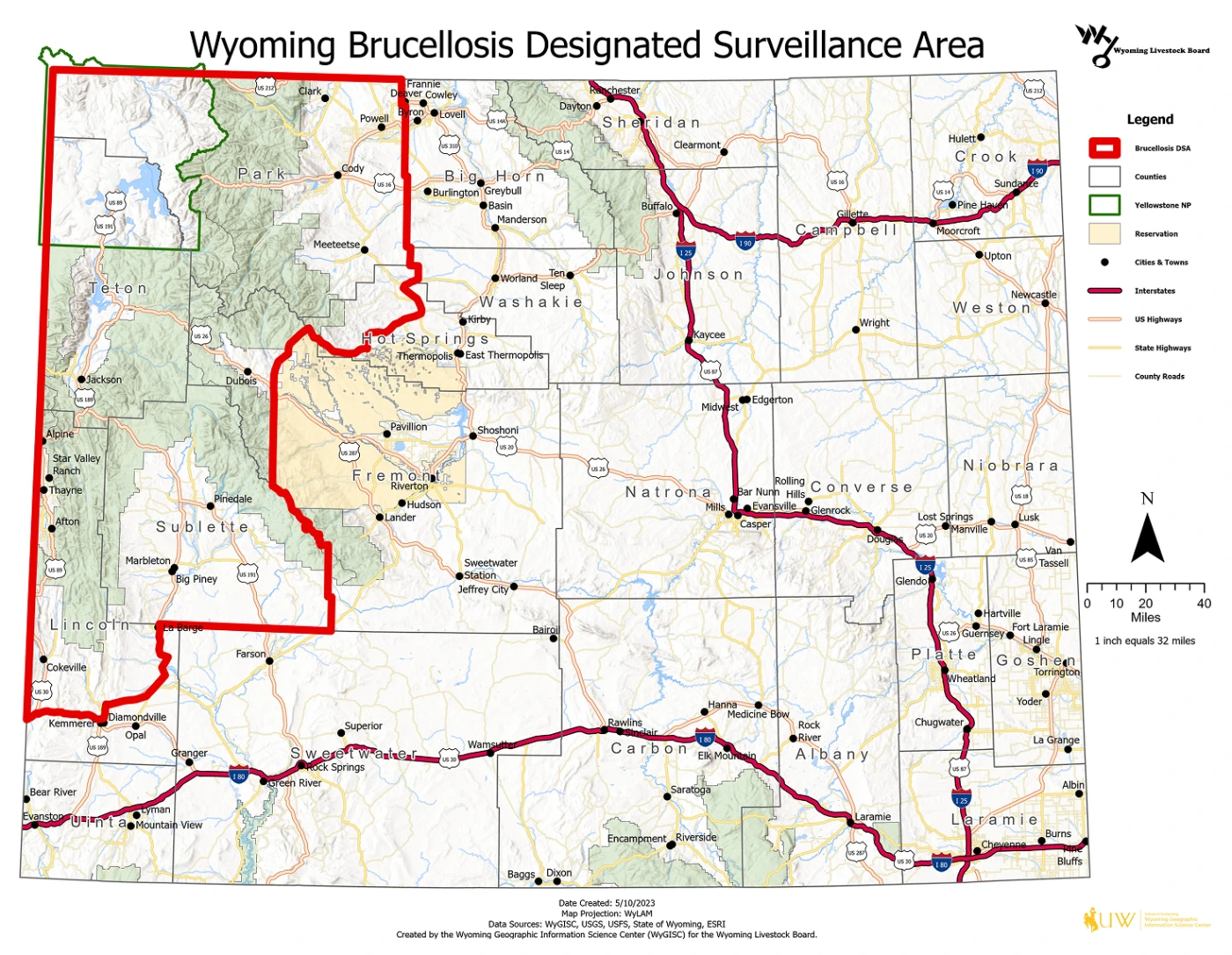
Brucellosis Designated Surveillance Area (DSA)
What is Wyoming’s Brucellosis Designated Surveillance Area (DSA)?
Wyoming’s Brucellosis Designated Surveillance Area is located in Northwest Wyoming, where brucellosis infected elk pose a risk of infection to cattle, bison, and yak. As a result, cattle, bison and yak are required to adhere to testing, vaccination, and identification requirements as determined in WLSB Chapter 2 Rules.
The DSA boundaries are established based on the location of brucellosis infected elk. Wyoming Game and Fish Department (WGFD) conducts brucellosis surveillance each year in elk. The WLSB annually reviews this data and assesses the DSA boundaries for changes in risk.
The goal of Wyoming’s DSA is to identify brucellosis infected livestock in a timely manner and ensure that brucellosis infected livestock do not leave the DSA. This program protects Wyoming producer’s ability to market cattle interstate and internationally.
1. Brucellosis Vaccination Requirements in the DSA
- Unvaccinated intact female cattle, bison and yak are not allowed to enter the DSA. Please contact 307-777-7515 if you have questions about this requirement.
- Brucellosis Vaccine eligible female cattle, bison and yak (4 months of age and older) residing in Wyoming’s Brucellosis Designated Surveillance Area must be vaccinated for brucellosis by February 1 each year.
- Official brucellosis calfhood vaccinates may be identified with either an 840 EID tag, a Wyoming OCV tag, or an orange metal NUES tag.
- Adult brucellosis vaccinates may be identified with an 840 EID tag or an orange metal NUES tag.
2. Requirements for Leaving the DSA
- Prior to leaving the DSA, all sexually-intact female cattle 12 months of age and older must test negative for brucellosis within 30 days.
- Any negative test result reported during the six-month period of August 16 and February 15 will be valid from the time of test until the end of that time period (February 15).
- Cattle tested for brucellosis must be identified with an 840 EID tag.
3. Identification Requirements for Heifers Leaving the DSA
- Heifers that have not been OCV: must be identified with an 840 EID tag prior to leaving the DSA.
- Heifers under 12 months of age, that have been OCV: may leave the DSA with an 840 EID tag, a Wyoming OCV tag, or an orange metal NUES tag.
- Heifers and cows over 12 months of age: Must be identified with an 840 EID tag. Regulatory testing (brucellosis, tuberculosis testing) requires an 840 EID tag. All sexually intact females 12 months of age and older must be brucellosis tested prior to leaving the DSA.
4. Requirements for Change of Ownership of DSA Cattle
- Prior to changing ownership, all sexually-intact female cattle 12 months of age and older must test negative for brucellosis within 30 days.
- Any negative test result reported during the six-month period of August 16 and February 15 will be valid from the time of test until the end of that time period (February 15).
- Cattle tested for brucellosis must be identified with an 840 EID tag.
- Before change of ownership, sexually-intact female cattle under 12 months of age must be identified with either an 840 EID tag or a Wyoming OCV tag.
5. Brucellosis Testing
Brucellosis testing involves collection of a blood sample. Only Category II Accredited veterinarians can draw blood to test for brucellosis. To schedule an appointment for brucellosis testing, contact your veterinarian. The State of Wyoming provides compensation to your veterinarian to cover the costs of brucellosis testing DSA cattle.Brucellosis testing is allowed at the following locations:
On the home premises in the DSA (*If you graze seasonally in the DSA and wish to test when you arrive home, contact WLSB Animal Health to inquire about the possibility of a waiver).
- Big Horn Basin Livestock Auction
- Riverton Livestock
- Torrington Livestock Market
Any approved out of state market (call WLSB at 307-777-7515 to confirm market approval).
Wyoming slaughter establishments that participate in the Wyoming Brucellosis Surveillance Program (ask your slaughter establishment if they test for brucellosis).
6. For DSA herds, annual whole herd testing of females 1 year of age and older is highly recommended.
- When brucellosis is identified early, it is much easier to eliminate the disease from a herd. Annual testing ensures reactors are removed from a herd before calving, preventing further spread within your herd.
- If you have a current Brucellosis Risk Mitigation Plan, the State of Wyoming provides compensation to your veterinarian to cover the costs of annual brucellosis testing DSA cattle.
7. Brucellosis Mitigation Plans
- Brucellosis Risk Assessment: A detailed, confidential questionnaire about an operation that is completed once every 5 years, or more frequently if significant changes occur to operation management. This is used to determine the brucellosis risk level of a herd.
- Brucellosis Mitigation Plan: This plan describes specific mitigation activities which the herd owner/manager agrees to perform. The plan is tailored to the herd’s brucellosis risk level, and is renewed annually.
- Reduced Brucellosis Risk
- Having a brucellosis mitigation plan promotes health of cows, calf crop, personnel, and minimizes loss from brucellosis infection.
- Cost Savings
- As outlined in your plan, your veterinarian is reimbursed for specific work which may include: brucellosis testing, brucellosis adult vaccination, and spaying heifers. This program passes the savings on to you.
- Brucellosis Test Waivers
- You may be allowed to move across the DSA boundary and brucellosis test at another location in Wyoming.
- Reduced Quarantine Requirements Under Specific Conditions
- With a brucellosis mitigation plan, non-negative brucellosis suspect cattle may be isolated while the remainder of the herd is allowed to ship.*
- *NOTE: This is not allowable when a brucellosis reactor is identified, and is dependent on destination state requirements.
- With a brucellosis mitigation plan, non-negative brucellosis suspect cattle may be isolated while the remainder of the herd is allowed to ship.*
Associated forms:
Questions?
Reimbursement Resources
Wyoming has a brucellosis surveillance program, and Wyoming Livestock Board reimburses veterinarians and custom slaughter plants for eligible brucellosis tests.Initial Setup
- A Taxpayer Identification Number (TIN). For most clinics and plants this is your business EIN. Sole proprietors without an EIN may use an SSN.
- A current W-9 on file with the State of Wyoming. Keep it updated whenever something changes, such as your address or type of business. An out-of-date W-9 will hold up payment. (link to current W-9)
- An email address for sending and receiving reimbursement documents. The whole process runs electronically.
- The Wyoming State Veterinary Laboratory (WSVL) sends your brucellosis test records to WLSB Animal Health.
- WLSB reviews each record and identifies the ones eligible for reimbursement under Chapter 6, Section 4 of the WLSB Rules. (Include rates in a table and link to the rules)
Reimbursement Rates
|
Activity |
Reimbursement Rate |
|---|---|
|
Ranch Tests |
$7.00 |
|
Market Tests |
$7.50 |
|
Market Labor |
$3.00 |
|
Custom Slaughter |
$5.50 |
|
Adult Booster Vaccination (Active Herd Plan) |
$4.00 |
|
Electronic Data Submission (Per Head) |
$0.25 |
5. WLSB builds and emails a reimbursement invoice for you to review.
One extra step for veterinarians
WLSB does not receive Adult Vaccination records from WSVL. If you have applicable Adult Vaccination records, add them to your monthly invoice yourself when you review the packet. (Custom slaughter plants do not have this step.)Questions?
Reimbursement Process
Step 1
The Wyoming State Veterinary Laboratory (WSVL) submits Brucellosis test records to the Wyoming Livestock Board Animal Health Unit.
Step 2
The Wyoming Livestock Board reviews submitted test records and determines reimbursement eligibility in accordance with Chapter 6 of the Wyoming Livestock Board Rules.
Step 3
The Wyoming Livestock Board prepares a reimbursement invoice and sends it electronically to the participating veterinarian or custom slaughter plant for review.
Step 4
The veterinarian or slaughter plant reviews the invoice, notes any corrections, and returns the documents to the Wyoming Livestock Board.
Step 5
The Wyoming Livestock Board finalizes the reimbursement packet and submits it for payment processing.
Educational Resources
Chapter 2: Brucellosis Management and Mitigation
Review Wyoming’s official regulations governing Brucellosis surveillance, management, and mitigation.